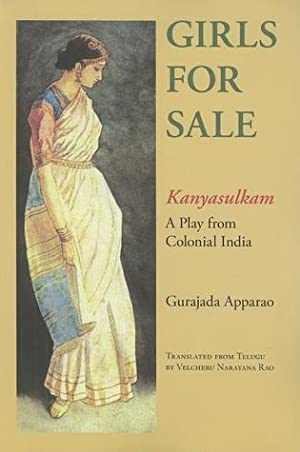
Quite a few people were taken aback by the title — Girls for Sale. The title comes from Kanyasulkam (Girl Money), a practice in Colonial India — groom pays a price for the bride to bride’s parents.
This practice becomes super evil when girls are married off by their parents to much older grooms for money. Life expectancy was not great those days, so most probably the groom dies early (like 40 or 50) and the bride becomes a widow, possibly before she reaches a sexually mature age. Widow marriage was a taboo in Brahmin society (and I think other castes just followed them blindly because (they think) Brahmins are the authority over religion and practices), so such girls lead a terrible life as a widow. (I can relate to this very well because my grand mother was married at age 6 to 18 year old groom; and is now spending about three quarters of her life as a widow.)
This book probably won’t appeal to people lacking Indian cultural context because there are so many subtle things in the play about caste system, rural life and colonial India. For Indians, this is a must read play to understand the transformation of marriage over the years.
I always thought Kanyasulkam was a practice in all castes, was surprised to know it was a practice only in the well-learned caste — Brahmins. (Due to this book, I learned the sub-castes within Brahmins and their roles in society.)
This play revolves around the marriage of Subbi whose father arranges her marriage to a much older groom, for money. Her uncle, his disciple and a pleasure-woman come together to stop the marriage. And Girisam, a good for nothing fellow wants to marry a young widow in the name of social reform, is also an important character.
Madhuravani’s character is awesome. As a pleasure-woman, she knows when and how to dominate men. Throughout the play, she doesn’t let any man take control of her nor does she love anyone. She knows very well her role in (then) society and what will secure her future.
All through the play, the characters speak for themselves and there is little to no author’s narration or voice (guess that’s how a play ought to be.) So, the play and each act/dialogue can be interpreted in many ways.
Overall, this play depicts the situation and practice of Kanyasulkam very well, and underscores the affects very well, in a way common people can understand. Though he took jibes at his contemporaries very well by mocking them through Girisam and Saujanya Rao characters. (understood this only after reading the commentary at the end.)
I like the commentary by translator at the end, which gave a completely alternate perspective about the play and if it indeed was aimed at social reform. The alternate perspective is that society will come together to stop the evils and there is no need for explicit reform as some of Apparao’s contemporaries thought/wrote.


